
Selected Works (2011–Present)
This selection presents works created by Ellen de Meijer since 2011, tracing the development of her portrait practice and recurring archetypes.
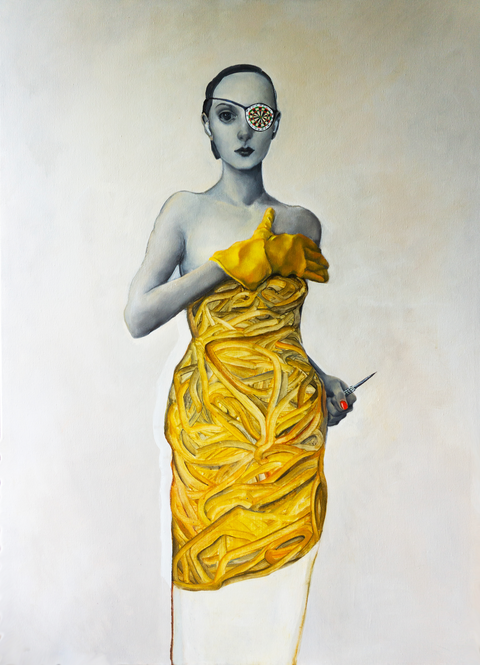
Description
This painting examines the fragile dynamics of visibility and power within contemporary digital culture. Set against ongoing debates around freedom of speech on open platforms, the figure embodies the instability of participation in public discourse—where exposure is both voluntary and coercive.
The subject occupies a dual position: at once assertive and exposed, complicit and endangered. Agency and vulnerability collapse into a single posture, reflecting how identity is negotiated under constant observation.
Artist’s note
“She is aggressor and victim at the same time. Vulnerable, yet assaultive.”
Details
- Year: 2024
- Dimensions: 39 × 55 in / 100 × 140 cm
- Medium: Oil on canvas
- Availability: Available for exhibition
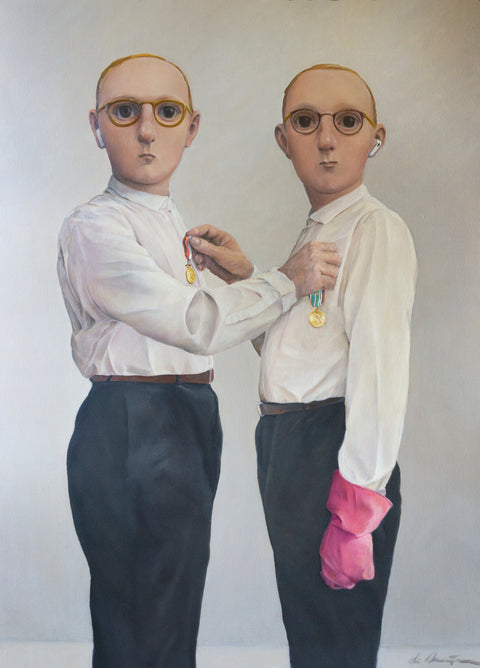
Description
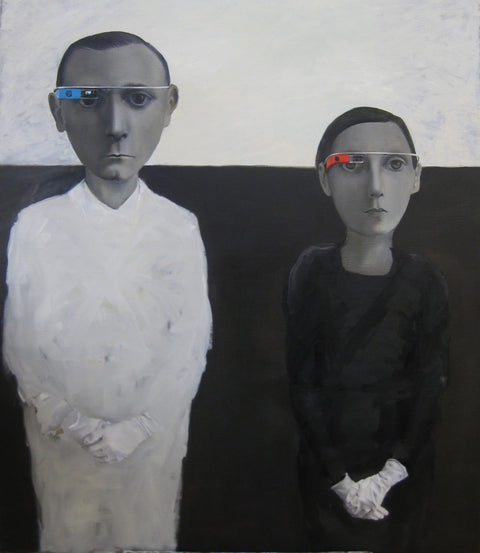
This painting addresses systems of lobbying and reciprocal power. Two nearly identical figures exchange medals in a closed circuit of recognition, their mirrored appearance underscoring the collapse of difference within structures of influence.
The shared AirPods suggest a synchronized worldview—an echo chamber in which authority circulates privately, insulated from scrutiny. Their upward gaze implies interruption, as though the transaction has been momentarily exposed.
Artist’s note
“Scratch my back and I’ll scratch yours.”
Details
- Year: 2023
- Dimensions: 45 × 63 in / 115 × 160 cm
- Medium: Oil on canvas
- Availability: Available for exhibition
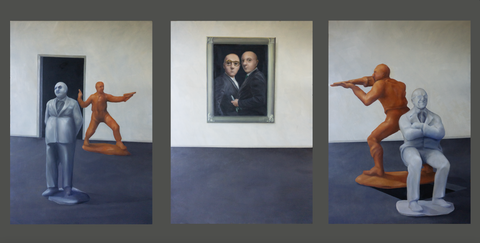
Description
In this triptych, de Meijer stages authority and aggression as manufactured spectacle. Two orange plastic army figures confront one another in frozen combat — one positioned beside a dark threshold, the other balancing at the edge of a void. Their materiality exposes them as symbols of power rather than agents of consequence.
In the foreground stand two businessmen cast in gray plastic, monumental yet immobilized. Between them hangs a portrait of business partners, one holding a model rocket — a gesture toward conquest and ambition. The composition suggests orchestration: rivalry and militarized posturing are not incidental but directed.
The work reflects on systems in which authority is concentrated and conflict becomes performance. As de Meijer notes, “Humanity is at the mercy of a few ego-driven men.”
Details
- Year: 2024
- Dimensions: triptych, each 55 x 67 inch / 140 x 170cm
- Medium: oil on canvas
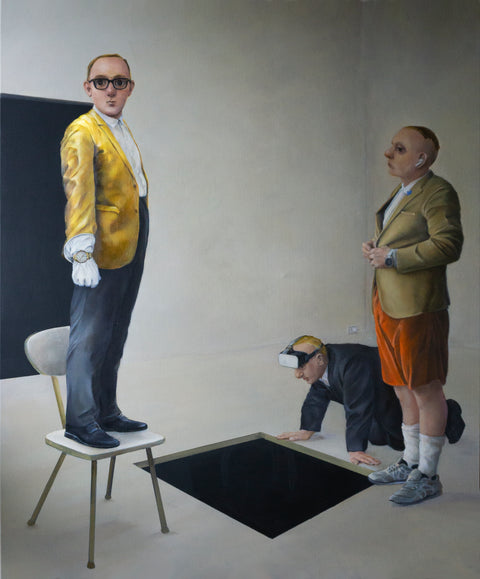
Description.
In WAGMI, three male figures gather around a dark opening in the floor — a void suggestive of ambition, speculation, and collective illusion. The scene unfolds as a contemporary allegory of wealth and hierarchy.
One man stands elevated in a gold jacket, displaying his watch as a symbol of financial ascent. Another kneels in virtual reality goggles, absorbed in a constructed world. A third leans forward, fixed on the emblem of status, poised between aspiration and exclusion.
The figures operate as archetypes within a system of modern success. Elevation, submission, and longing structure the composition, exposing how contemporary wealth is sustained as much by belief and projection as by material gain. The central void becomes a site into which desire — and capital — are poured.
Details
- Year: 2023
- Dimensions: 55 x 67 inch / 140 x 170cm
- Medium: oil on canvas
Description
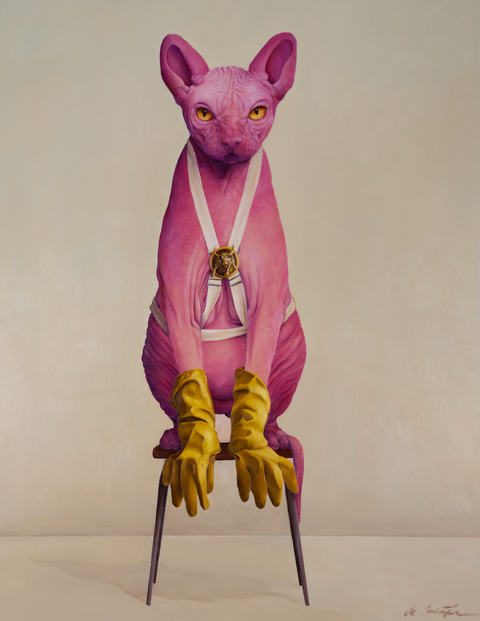
In Mommy’s Non-Fungible Finest, a gloved and theatrically posed cat appears transformed into a speculative asset. Its stance subtly echoes the Wall Street bull, invoking the optimism and volatility of financial markets.
The animal functions less as subject than as proxy. Tokenized and abstracted, ownership shifts from intimacy to exchangeable value. The gloves suggest profit without touch — capital generated at a distance from consequence.
Ultimately, the painting becomes a portrait of its unseen owner and a commentary on NFT-era speculation, exposing a system in which value is performed and detached from labor or meaning.
Details
- Year: 2022
- Dimensions: 70 x 55 inch / 200 x 140 cm
- Medium: oil on canvas
Description
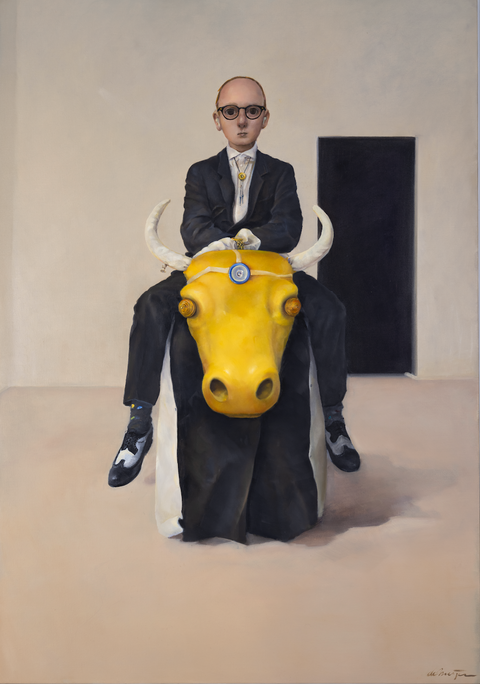
In Mining Crush, a suited businessman rides a mechanical bull with rodeo poise, miner’s headlamp aglow — a figure suspended between spectacle and speculation.
The bull, emblem of financial ascent, is rendered as a machine, underscoring the engineered volatility of contemporary markets. The headlamp evokes extraction, suggesting value must be relentlessly mined within systems built for acceleration.
As archetype, he appears confident yet tethered to forces beyond control. Mining Crush reflects on the seduction of financial conquest — and the fragile belief that volatility can be mastered.
Details
- Year: 2021
- Dimensions: 78 x 55 inch / 200 x 140 cm
- Medium: oil on canvas
Description
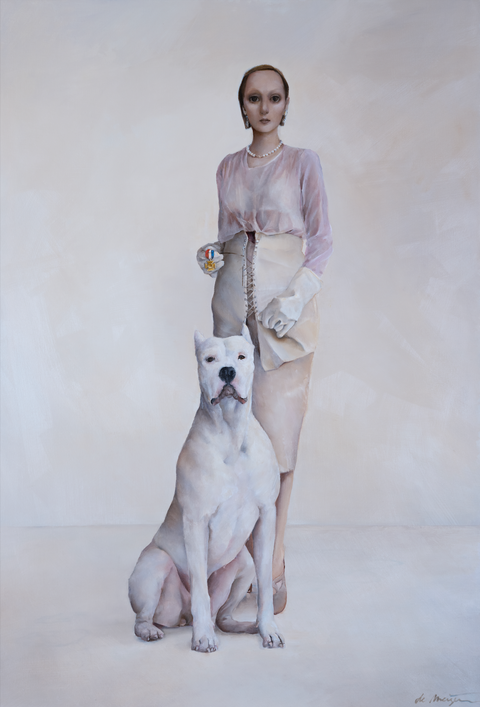
High Profile presents a composed businesswoman standing beside a Dogo Argentino — both figures aligned in posture and presence. The pairing suggests pride, authority, and cultivated control.
The woman’s medal and pearl necklace signal recognition and achievement, while her loosely laced corset introduces tension between restraint and autonomy. The dog, positioned protectively before her, mirrors her strength and composure. Together, they form a unified archetype of status — disciplined, guarded, and self-aware.
Artist’s note
“I wanted the dog and its owner to almost transcend in each other.”
Details
- Year: 2022
- Dimensions: 75 x 51 inch / 200 x 140 cm
- Medium: oil on canvas
Description
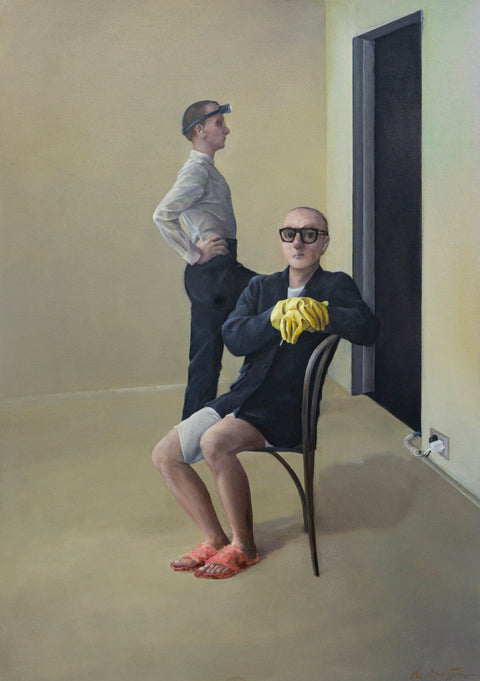
In Crypto Craze, a dark doorway evokes the data center as a contemporary goldmine — a portal to digital extraction. A suited figure stands ready to descend, miner’s lamp lit, while another waits passively for profit, insulated from labor.
The contrast stages a commentary on speculative wealth and the widening divide between those who build digital systems and those who benefit from them. As in much of de Meijer’s work, the figures function as archetypes within a shifting economy shaped by illusion, acceleration, and unequal access.
Details
- Year: 2021
- Dimensions: 78 x 55 inch / 200 x 140 cm
- Medium: oil on canvas
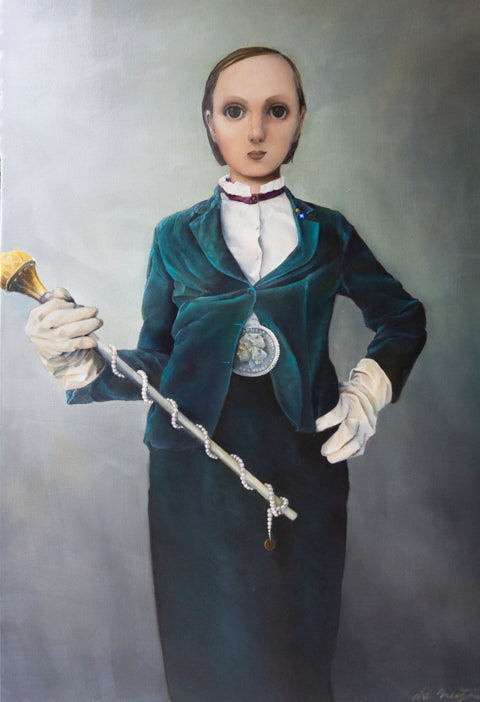
Description
In Power Play, a commanding female figure stands poised with a majorette baton — an object of spectacle turned instrument of authority. The baton, adorned with pearls, and her oversized belt buckle marked with a silver dollar anchor the image in the language of wealth and control.
Rather than a personal portrait, the figure functions as an archetype in which femininity, ambition, and economic power converge. The work reflects on how authority is staged and performed within systems shaped by material success.
Details
- Year: 2021
- Dimensions: 59 x 49 inch / 150 x 100 cm
- Medium: oil on canvas
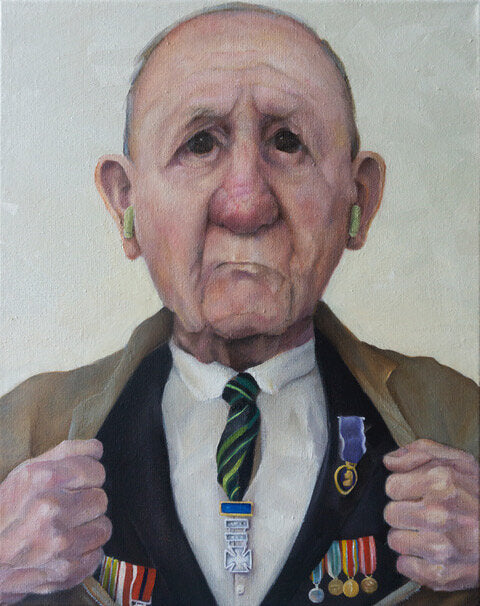
Description
Created during a period when patriotism dominated public discourse, The True Patriot portrays a World War II veteran holding open his jacket to reveal his medals. His steady gaze and worn features convey lived history rather than spectacle.
The painting contrasts authentic service with performative nationalism, suggesting that true patriotism resides not in rhetoric but in sacrifice. Through restrained composition and psychological depth, de Meijer reframes status as something earned quietly, not proclaimed loudly.
Details
- Year: 2021
- Dimensions: 19 x 15 inch / 50 x 40 cm
- Medium: oil on canvas
- Availability: Placed
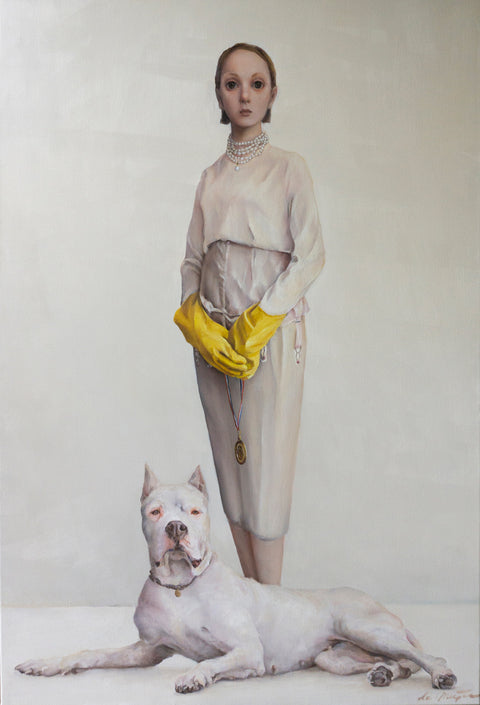
Description
In Soul Mates 2.0, an elegantly dressed woman stands beside her dog, both adorned and subtly restrained. Her corset and medal signal achievement and conformity to social expectations, while the dog—wearing a necklace integrated into its leash—mirrors her condition.
The pair function as reflections of one another, bound by loyalty, possession, and image. The work examines how status can simultaneously empower and confine, revealing the quiet constraints embedded within material success and curated identity.
Details
- Year: 2020
- Dimensions: 62 x 43 inch / 157 x 109 cm
- Medium: oil on canvas
- Availability: Placed
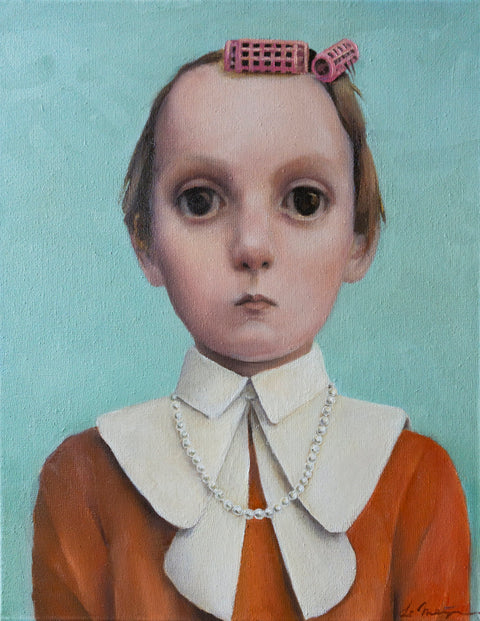
Description
In Eve (Gen Z), a young girl stands dressed in her mother’s clothing, rehearsing the gestures and symbols of adulthood. The scene captures a tender yet charged moment of identity in formation.
The oversized garments suggest inherited roles and expectations absorbed before they are fully understood. Presented as a diptych with 4th Generation Bill, the work reflects on generational continuity—how authority, ambition, and social positioning are quietly passed down over time.
Details
- Year: 2020
- Dimensions: 15.7 x 19.7 inch / 40 x 50 cm
- Medium: oil on canvas
Description
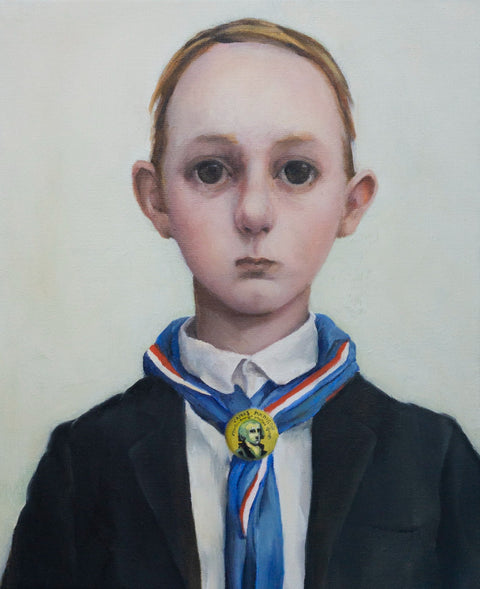
In 4th Generation Bill, a Boy Scout stands composed and resolute — an emblem of inherited ideals such as duty, justice, and responsibility. His uniform functions as both armor and legacy, signaling values passed down through generations.
Rather than portraying a specific child, de Meijer presents an archetype shaped by expectation and continuity. Paired with Eve (Gen Z), the work reflects on how youth negotiate tradition within a shifting social landscape — positioned between inheritance, resistance, and renewal.
Details
- Year: 2020
- Dimensions: 15.7 x 19.7 inch / 40 x 50 cm
- Medium: oil on canvas
Description
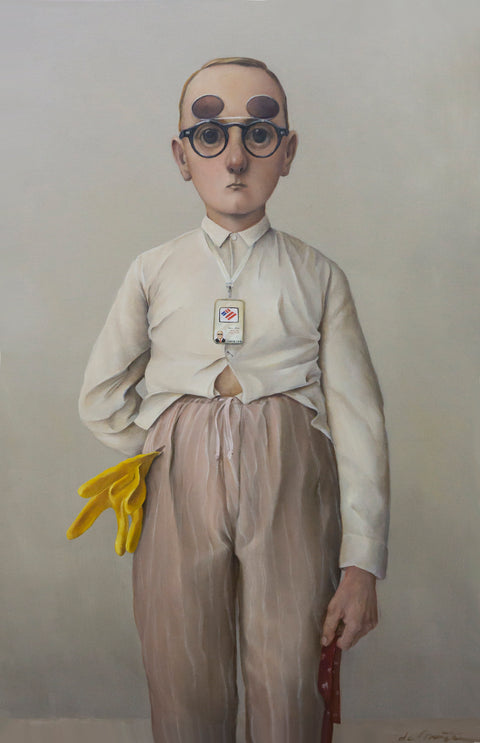
In Exposure, a bank employee stands prepared for a Zoom call: shirt buttoned, tie in hand — yet still wearing pajama trousers. Created during the COVID-19 pandemic, the painting satirizes the split between public presentation and private reality.
The subtly revealed midriff underscores the fragility beneath professional performance. De Meijer captures a moment emblematic of remote work culture, where authority is staged from domestic space and vulnerability quietly interrupts the façade.
Details
- Year: 2020
- Dimensions: 39 x 59 inch / 100 x 150 cm
- Medium: oil on canvas
- Availability: Placed
Description
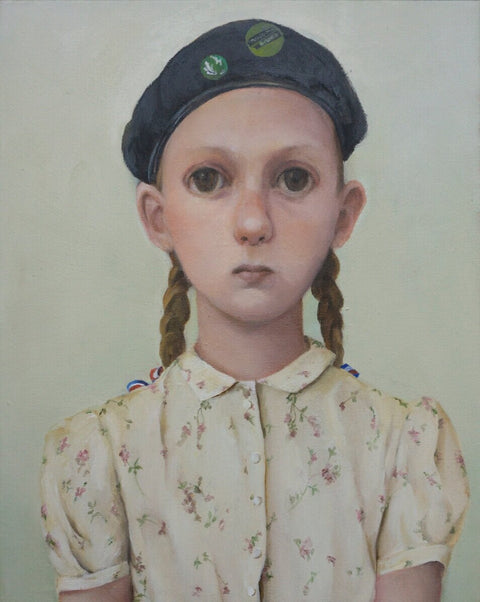
In 4th Generation Beth, a young girl stands composed, wearing the insignia of the Extinction Rebellion movement. Her calm, direct gaze contrasts with the urgency her symbols imply, positioning youth at the forefront of climate resistance.
Rather than portraying a specific individual, de Meijer presents an archetype of generational activism — a child inheriting environmental consequence while simultaneously embodying hope and defiance. The work reflects on how resistance is no longer optional for the young, but embedded within their identity and future.
Details
- Year: 2020
- Dimensions: 15.7 x 19.7 inch / 40 x 50 cm
- Medium: oil on canvas
- Availability: Placed
Description
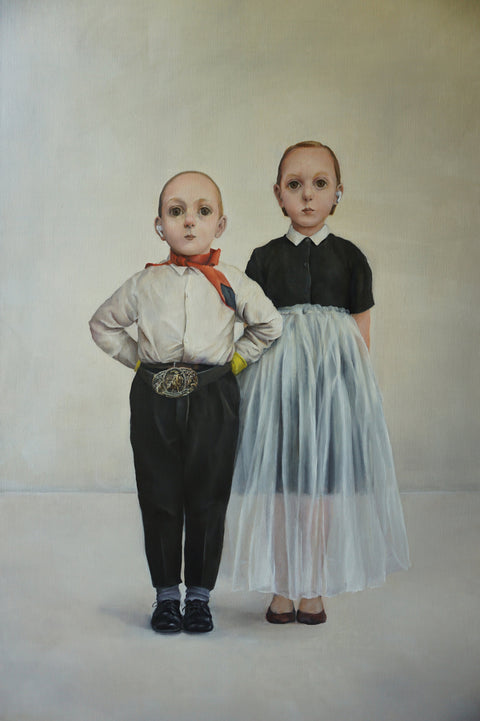
In Startup, two children stand dressed in their parents’ clothing, rehearsing adulthood with quiet seriousness. The girl wears her mother’s skirt; the boy adopts his father’s tie. A shared set of earplugs subtly links them, suggesting inherited narratives absorbed before they are fully understood.
Rather than portraying playful imitation, de Meijer frames the scene as early conditioning — a study of how ambition, roles, and belief systems are modeled and internalized. The work reflects on generational transmission: how identity begins not from scratch, but from example.
Details
- Year: 2020
- Dimensions: 47 x 70 inch / 120 x 180 cm
- Medium: oil on canvas
- Availability: Placed
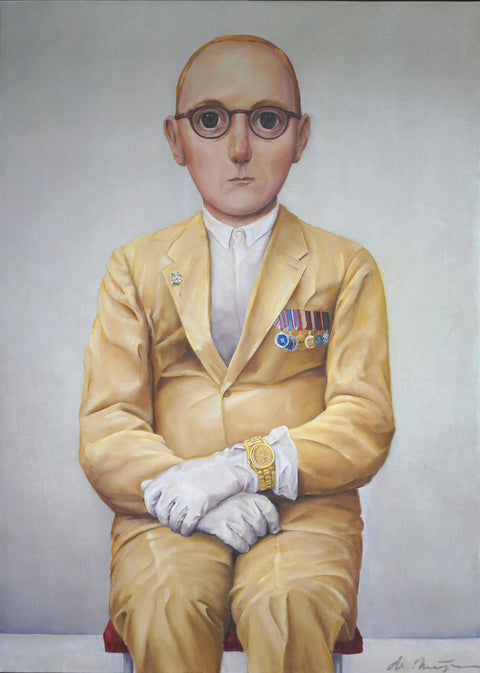
Description
In Bullish, a man in a gleaming gold suit sits rigidly, his medals and watch displayed with ceremonial precision. His expression remains controlled, almost vacant, as symbols of achievement accumulate across his body.
De Meijer presents him as an archetype of financial triumph — polished, decorated, and insulated. Yet the stillness of the figure undercuts the spectacle of success. The work questions whether status and visible wealth resolve the deeper tensions they attempt to conceal.
Details
- Year: 2020
- Dimensions: 39 x 55 inch / 100 x 140 cm
- Medium: oil on canvas
- Availability: Placed
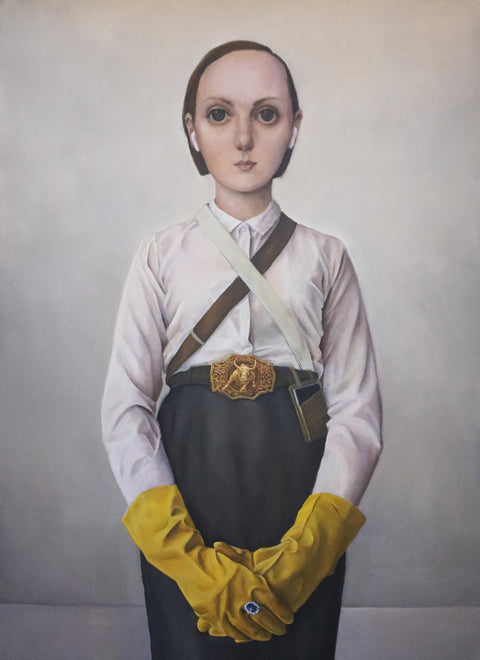
Description
In Lapis Lazuli, de Meijer constructs a portrait that operates simultaneously within the traditions of classical European figuration and contemporary socio-economic critique. The centrally positioned female figure stands with composed restraint, her posture recalling devotional portraiture, yet her iconography belongs unmistakably to the architecture of modern finance.
The yellow gloves — a recurring motif in de Meijer’s oeuvre — function as both barrier and display. The conspicuously worn gemstone ring, placed over the glove rather than beneath it, transforms ornament into spectacle: value is not merely possessed but exhibited. The oversized belt buckle and crossed leather straps introduce a subtle historical reference, invoking military regalia and civic authority. These elements destabilize the image, merging contemporary Wall Street symbolism with vestiges of past hierarchies.
Rather than presenting a psychological portrait, de Meijer stages an archetype — a composite of professional ambition, material accumulation, and emotional containment. The painting interrogates the aesthetics of power: how wealth is ritualized, how status is worn, and how identity becomes structured through systems of valuation.
The title’s reference to lapis lazuli — historically associated with rarity, sacred imagery, and ultramarine pigment — deepens the work’s meditation on material worth. Once mined for the most revered paintings of the Renaissance, the stone here becomes a metaphor for contemporary extraction and symbolic capital.
In this work, de Meijer does not merely critique wealth; she anatomizes its visual language.
Details
- Year: 2020
- Dimensions: 39 x 55 inch / 100 x 140 cm
- Medium: oil on canvas
- Availability: Placed
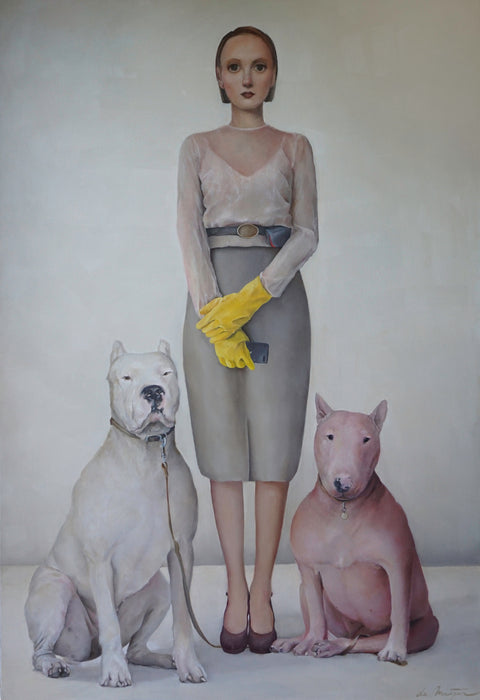
Description
In Tri State, a centrally positioned female figure stands flanked by two bull terriers, forming a controlled and symmetrical triad. The composition evokes both heraldic portraiture and contemporary corporate iconography, merging classical balance with modern authority.
The dogs function not merely as guardians but as extensions of the protagonist’s presence — doubling her vigilance and strength. The triangular arrangement suggests a tension between dominance, loyalty, and latent aggression. Rather than portraying individual psychology, de Meijer constructs an archetype of contemporary power: composed, guarded, and structurally reinforced.
Details
- Year: 2019
- Dimensions: 55 x 82 inch / 140 x 210 cm
- Medium: oil on canvas
- Availability: Placed
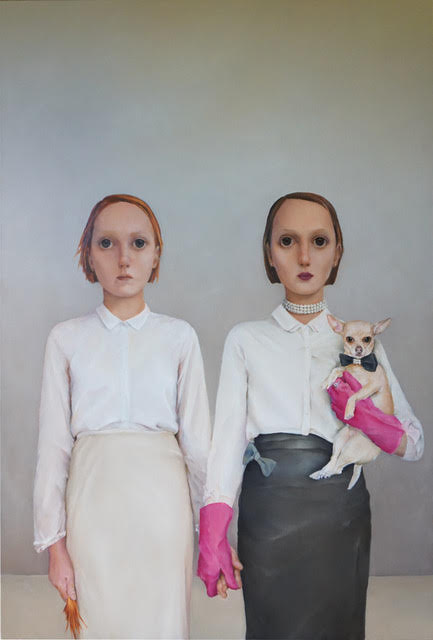
Description
Cassandra 2.0 reinterprets the mythological prophetess through a contemporary lens. Two female figures stand joined by the hand, staged within a stark, neutral space that heightens their ritualized stillness. The younger figure’s cut lock of hair introduces an act of quiet rupture — a symbolic gesture of sacrifice or initiation.
The painting examines transmission: of power, ambition, and belief. The title’s “2.0” signals a modern iteration of prophecy — one in which warnings persist, yet remain unheard. De Meijer positions authenticity as precarious within systems shaped by wealth and status, suggesting that foresight does not necessarily grant agency.
Details
- Year: 2019
- Dimensions: 41 x 61 inch / 105 x 155 cm
- Medium: oil on canvas
- Availability: Placed
Description
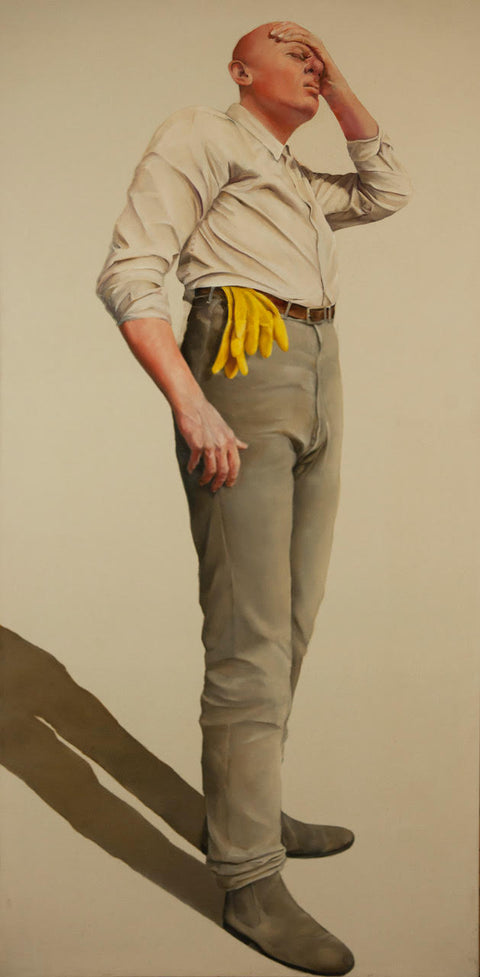
In Barking in the Desert, a solitary figure stands beneath an unrelenting sun in a landscape devoid of shelter. The barren terrain functions as both physical setting and psychological space — a site of exposure where denial can no longer endure.
The man’s stillness suggests confrontation rather than action. De Meijer presents him as an archetype suspended at a threshold: between awareness and resistance, collapse and transformation. Environmental precarity merges with internal reckoning, marking the moment when inherited systems can no longer be sustained.
Details
- Year: 2019
- Dimensions: 39 x 79 inch / 100 x 200 cm
- Medium: oil on canvas
Description
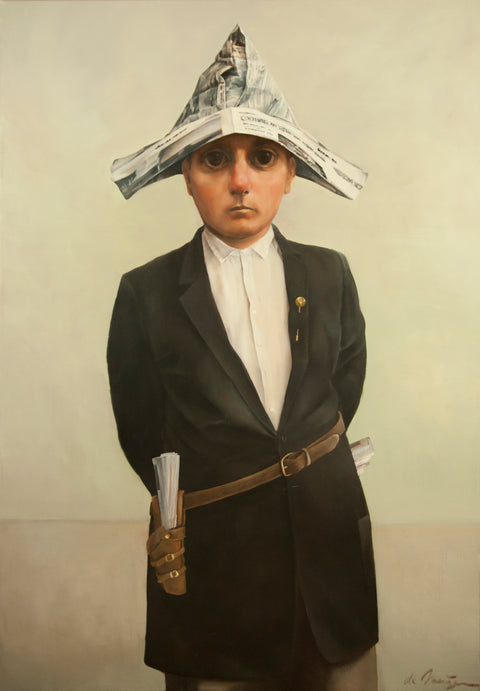
A suited male figure stands with a folded newspaper hat reminiscent of Napoleon’s bicorne. A leather holster at his side carries documents rather than weapons.
In Infocalypse, de Meijer examines the militarization of information in the digital age. The Napoleonic reference evokes historical conquest, while the newspaper — fragile yet ubiquitous — becomes a contemporary instrument of authority. Power here is exercised not through physical force but through narrative control.
The work situates the figure within a landscape shaped by media excess, algorithmic amplification, and blurred distinctions between truth and fabrication. By framing information as both costume and armament, de Meijer reflects on a cultural moment in which perception itself becomes territory.
Details
- Year: 2019
- Dimensions: 43 x 62 inch / 110 x 160 cm
- Medium: oil on canvas
- Availability: Placed
Description
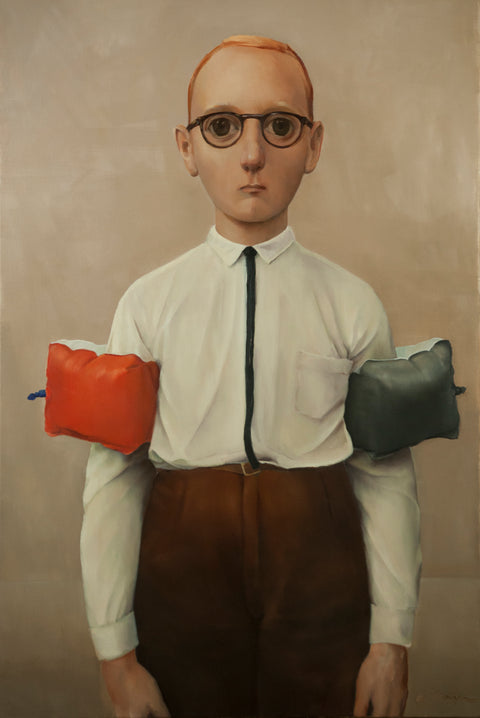
A young professional stands wearing inflatable water wings, their presence subtly incongruous within an otherwise restrained portrait. One wing is darkened, suggesting mourning or residue.
In Floating Regret, de Meijer addresses the psychology of environmental crisis. The flotation devices — instruments of safety — appear anticipatory rather than reactive, implying awareness without transformation. The figure’s composed stance contrasts with the symbolic urgency embedded in the accessories.
Rather than depicting catastrophe directly, the painting stages a suspended moment of collective hesitation. Preparedness becomes performative; acknowledgment does not yet translate into systemic change. The work positions climate anxiety as a condition of modern identity — visible, internalized, and unresolved.
Details
- Year: 2019
- Dimensions: 43 x 59 inch / 110 x 150 cm
- Medium: oil on canvas
- Availability: Placed
Description
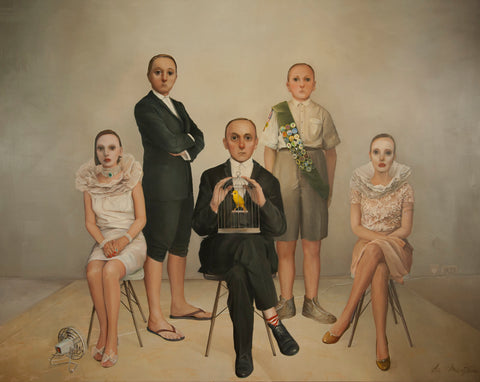
A family group is arranged in formal portrait formation, seated and standing against a restrained, neutral ground. The composition recalls 17th-century Dutch civic portraiture, yet its atmosphere is subtly unsettled. A small electric fan rests on the floor. A bird sits confined within a cage held at the center of the image. Sunscreen, medals, corporate attire, and scout insignia operate as contemporary heraldry.
De Meijer constructs the scene as a staged tableau — a domestic pageant of status under environmental duress. The patriarch’s composed authority is mirrored by the controlled stillness of the women, whose cosmetic preparation suggests protection not only from heat but from exposure. The child’s decorated sash introduces a generational counterpoint: aspiration framed within systems already destabilized.
Rather than dramatizing catastrophe, Air suspends its figures in a condition of anticipatory tension. Climate, legacy, and social performance converge in a single, carefully calibrated arrangement. The bird — confined yet upright — becomes a quiet emblem of fragility within inherited structures of power.
The painting operates less as narrative than as theatre, positioning the contemporary family as both subject and stage within an atmosphere increasingly difficult to sustain.
Details
- Year: 2019
- Dimensions: 74 x 94 inch / 190 x 240 cm
- Medium: oil on canvas
- Availability: Placed
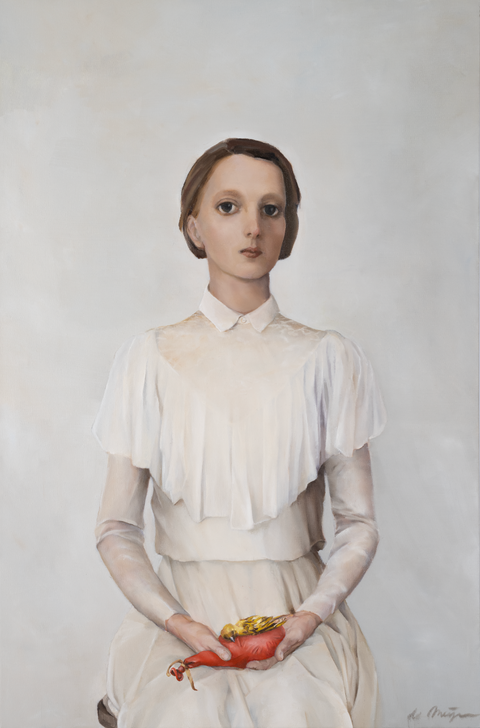
Decription
A solitary female figure stands composed, holding a lifeless bird suspended from a translucent plastic balloon. The gesture is restrained, almost liturgical. There is no overt drama — only the quiet presentation of evidence.
The painting’s tonal restraint recalls the bleached luminosity of Arctic terrain. Her finely articulated dress echoes the brittleness of ice fields, its delicacy set against the inert weight of the bird. Plastic — light, buoyant, indestructible — becomes a material antagonist: a contemporary relic intruding upon ecological fragility. The balloon’s artificial lift contrasts with the bird’s irrevocable fall.
As in much of de Meijer’s practice, the figure operates as archetype rather than portrait. She is neither activist nor victim, but a composed intermediary — holding the consequence of environmental erosion within a controlled, almost ceremonial posture. The indictment is not shouted; it is displayed.
Rather than dramatizing catastrophe, Arctic Indictment renders climate crisis as suspended stillness. Responsibility lingers in the space between gesture and object, implicating both subject and viewer within a system of consumption whose lightness conceals irreversible weight.
Details
- Year: 2018
- Dimensions: 39 x 59 inch / 100 x 150 cm
- Medium: oil on canvas

Description
In Dress Code, a young girl stands equipped in protective attire that reads less as play than as necessity. The garments function as adaptation — a visual language of precaution shaped by environmental instability rather than imagination.
Her outfit evokes contemporary defenses against rising waters, polluted air, and volatile climates. Protection becomes part of her formation. What should signal childhood instead suggests preparedness. The figure embodies a generation inheriting conditions it did not author, yet must navigate with composure.
As in much of de Meijer’s work, the subject is archetypal. She stands neither alarmed nor theatrical, but alert — poised within a reality already altered. Dress Code reframes youth not as innocence, but as a site of early vigilance. The painting locates ecological crisis within identity itself, where resilience becomes less choice than requirement.
Details
- Year: 2018
- Dimensions: 41 x 61 inch / 105 x 155 cm
- Medium: oil on canvas
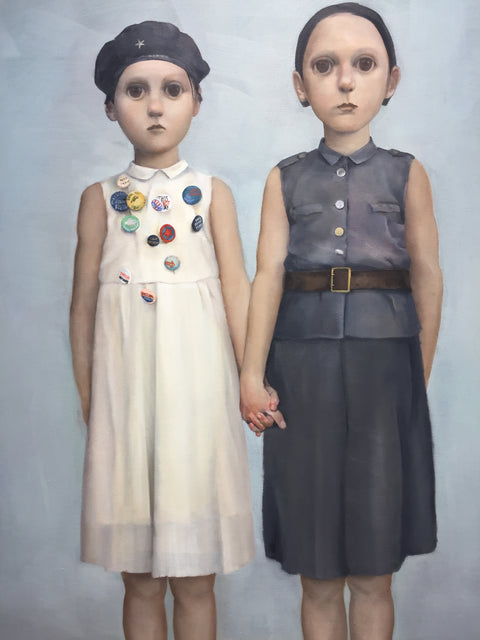
Description
In Not Mine, two young girls stand hand in hand, their direct gaze and composed posture counterbalancing the political charge embedded in their attire. One wears a dress adorned with protest buttons; the other dons a beret and utilitarian uniform. The pairing evokes historical imagery of revolution, yet the figures remain unmistakably children.
De Meijer reframes resistance through the language of inheritance. The girls appear less as agitators than as carriers of ideology — absorbing symbols of dissent before fully inhabiting their meaning. Their stillness resists spectacle; rebellion is rendered quiet, almost ceremonial.
Rather than dramatizing protest, Not Mine examines how political consciousness is transmitted across generations. The work situates resistance within childhood itself, suggesting that refusal — the act of saying “not mine” — may begin as an early gesture of separation from inherited systems.
Details
- Year: 2017
- Dimensions: 39 x 59 inch / 100 x 150 cm
- Medium: oil on canvas
- Availability: Placed
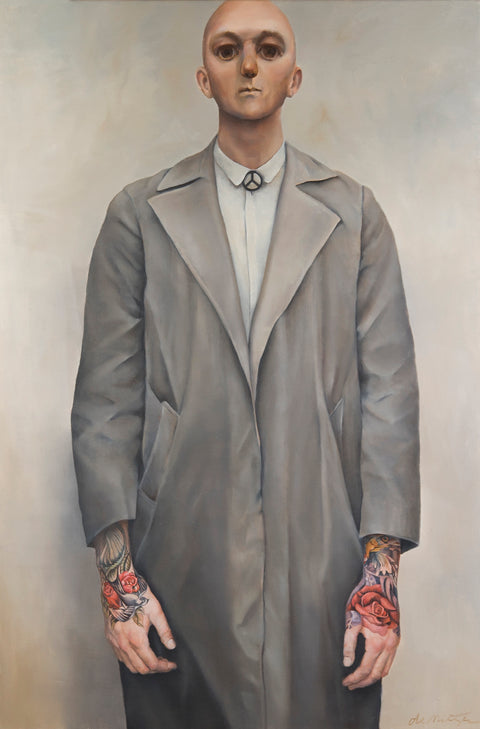
Description
In Flower Power, a solitary male figure stands frontally, clad in a sober overcoat that evokes institutional authority. The restraint of his attire is disrupted by vividly tattooed hands, where floral imagery emerges as both ornament and quiet defiance.
De Meijer destabilizes the binary between conformity and rebellion. The figure appears neither fully aligned with corporate order nor wholly outside it; instead, resistance is inscribed directly onto the body. The tattoos operate as a private manifesto — creativity and dissent embedded beneath a surface of composure.
Rather than romanticizing counterculture, the painting reflects on how opposition is absorbed, aestheticized, and recoded within contemporary systems of power.
Details
- Year: 2017
- Dimensions: 39 x 59 inch / 100 x 150 cm
- Medium: oil on canvas
- Availability: Placed
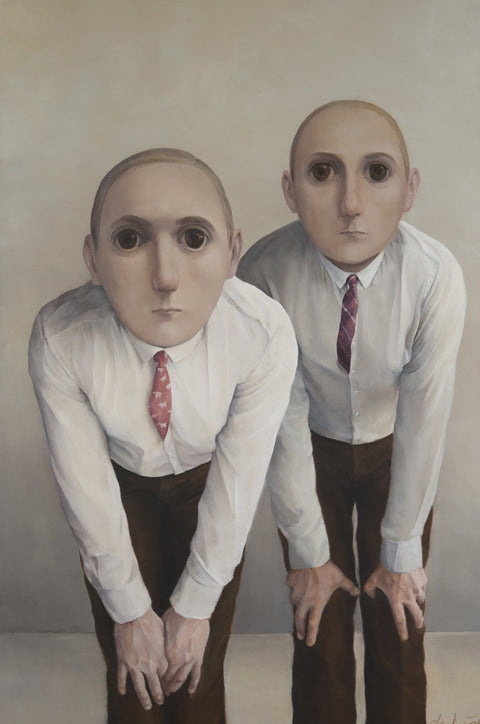
Description
In Countdown, two suited men lean forward in tense anticipation, their posture suggesting submission to an unseen force beyond the frame. The ambiguity of their gaze — toward a screen, a market, a metric — situates the scene within the architecture of financial speculation.
De Meijer captures the psychological choreography of market culture: vigilance, anxiety, dependency. The figures’ synchronized stance renders them almost interchangeable, subsumed within the logic of acceleration and risk.
Countdown reframes economic activity as a ritual of waiting and wagering, where agency appears suspended and value exists primarily as abstraction.
Details
- Year: 2017
- Dimensions: 39 x 59 inch / 100 x 150 cm
- Medium: oil on canvas
- Availability: Placed
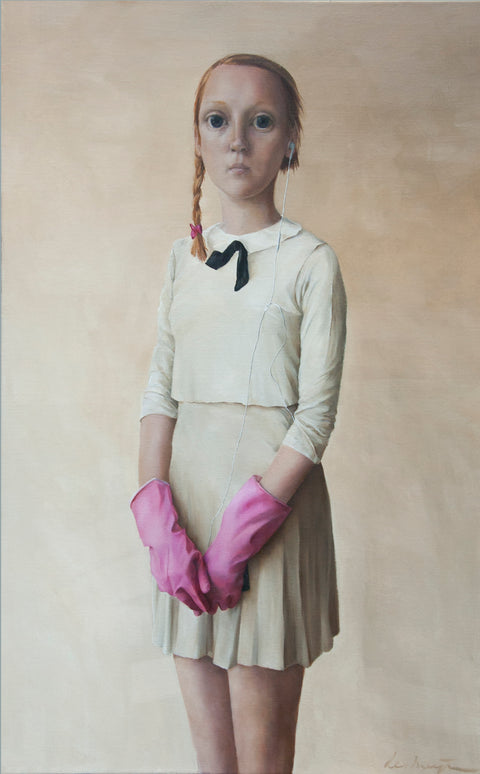
Description
In Initiation, a young girl stands poised at the threshold between childhood and adulthood. Her posture is composed, yet the gesture of a severed braid introduces a quiet rupture — a visible mark of transition. The second braid remains intact, signaling hesitation within transformation.
De Meijer frames this moment not as sentimental coming-of-age, but as entry into a system structured by competition and performance. The pink gloves and discreet earpiece subtly evoke the codes of professional assimilation, suggesting that innocence is not simply lost but reconditioned.
Rather than dramatizing change, Initiation captures its suspension: the instant before absorption into the so-called “rat race,” where identity is reshaped by expectation, ambition, and inherited economic rituals.
Details
- Year: 2016
- Dimensions: 59 x 47 inch / 150 x 135 cm
- Medium: oil on canvas
- Availability: Placed
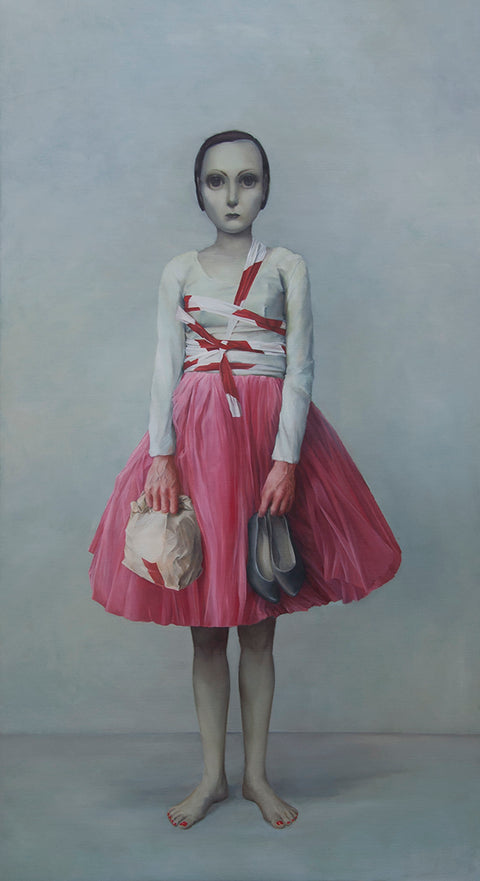
Description
In Quality Time No. 1, a female figure stands at the end of the working day, barefoot and visibly fatigued. Her body is bound in strips of red-and-white tape, a subtle yet forceful metaphor for containment and self-regulation within competitive systems. In one hand she carries takeaway food; in the other, her high heels — markers of professional performance temporarily set aside.
De Meijer constructs a portrait of ambition’s aftermath. The figure appears suspended between roles, caught in the tension between productivity and personal depletion. The tape becomes both barrier and costume, suggesting that identity is carefully wrapped, secured, and constrained within contemporary career structures.
Rather than dramatizing burnout, the painting renders exhaustion as composed stillness — a quiet indictment of the demand to sustain appearance while interior resources diminish.
Details
- Year: 2016
- Dimensions: 87 x 47 inch / 220 x 120 cm
- Medium: oil on canvas
- Availability: Placed
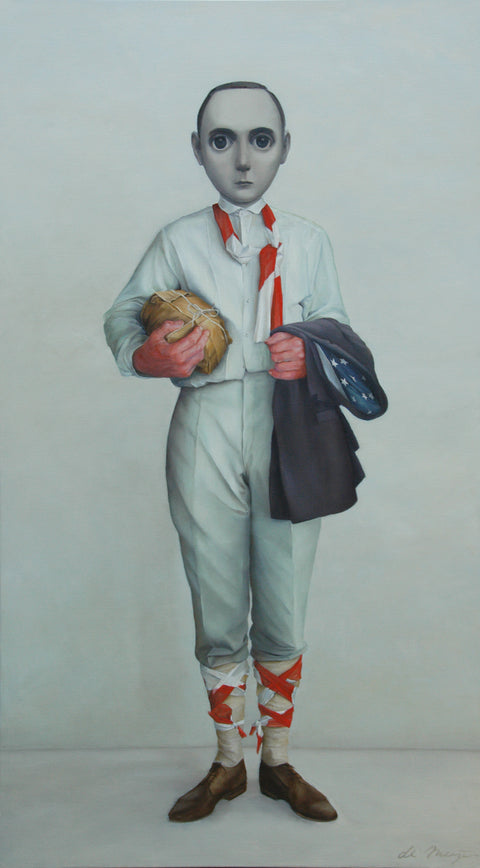
Description
In Quality Time No. 2, a male figure stands at day’s end, still marked by the codes of professional life. His tie and shirt remain formal, yet red tape binds his wrists and ankles — an understated sign of systemic constraint. Under one arm he carries a folded jacket; in the other, a gift-wrapped rugby ball intended for his child.
The painting stages the uneasy intersection of labor and intimacy. The gesture of bringing home a symbol of play contrasts with the visible marks of obligation, suggesting that even leisure is framed within performance and expectation.
De Meijer reframes “quality time” as negotiated time — compressed between productivity and presence. The figure’s composed expression underscores the paradox: participation in the game of success requires endurance, yet its rewards remain mediated by structure and ritual.
Details
- Year: 2016
- Dimensions: 87 x 47 inch / 220 x 120 cm
- Medium: oil on canvas
- Availability: Placed
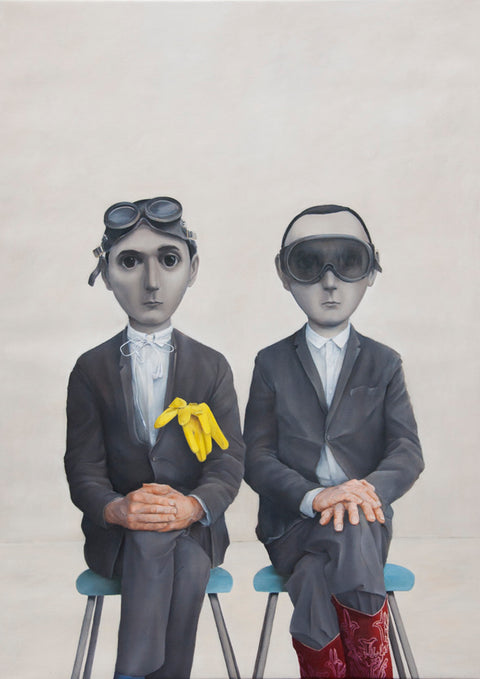
Description
In Burning Ambition, two suited men sit side by side in composed symmetry, their posture restrained and formal. Yet their attire fractures convention: protective desert goggles, cowboy boots, and a single bright yellow glove interrupt the uniform language of corporate dress. The image stages a collision between institutional conformity and the longing for rupture.
The reference to Burning Man operates less as anecdote than as allegory. De Meijer positions the figures at the threshold between order and release, asking whether liberation can coexist with the structures it seeks to escape. Their stillness suggests not rebellion enacted, but rebellion imagined — a carefully contained deviation within an otherwise disciplined system.
As in much of her practice, the figures function as archetypes of contemporary ambition: individuals who desire transcendence yet remain tethered to the codes of status and performance. Burning Ambition reflects on the commodification of counterculture, where even gestures of freedom risk becoming extensions of the very systems they aim to resist.
Details
- Year: 2015
- Dimensions: 71 x 51 inch / 180 x 130 cm
- Medium: oil on canvas
- Availability: Placed
Description
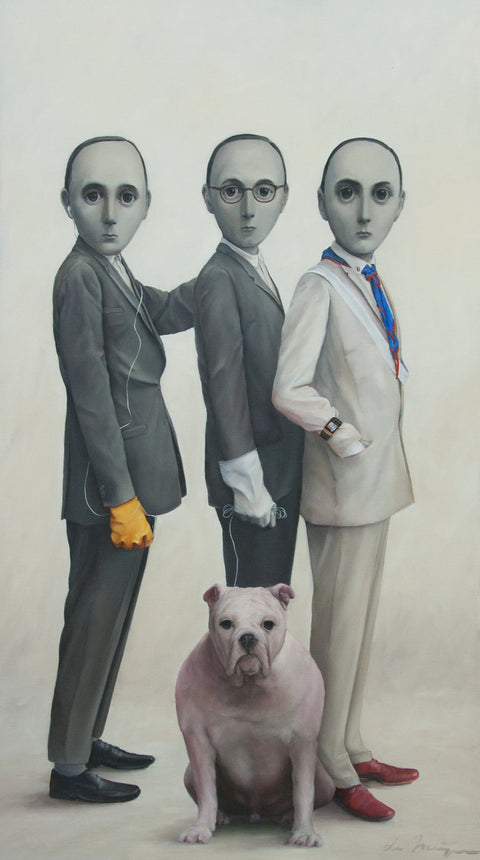
In Followers, three suited men stand in rigid alignment, their gazes fixed outward, their bodies nearly interchangeable. A pale dog sits at their feet — a quiet emblem of loyalty and submission. Hierarchy is suggested through subtle shifts in attire and posture, yet individuality dissolves within uniformity.
De Meijer constructs a portrait not of specific figures, but of a social formation governed by compliance. Authority circulates between them rather than residing in one body; power appears rehearsed rather than earned. The composition evokes the choreography of corporate culture, where ambition and allegiance become indistinguishable.
Followers examines how conformity sustains systems of status. The painting suggests that leadership and obedience often mirror one another — each dependent on shared belief in the rules that structure visibility, success, and belonging.
Details
- Year: 2011
- Dimensions: 78 x 47 inch / 200 x 120 cm
- Medium: oil on canvas
- Availability: Placed
Description
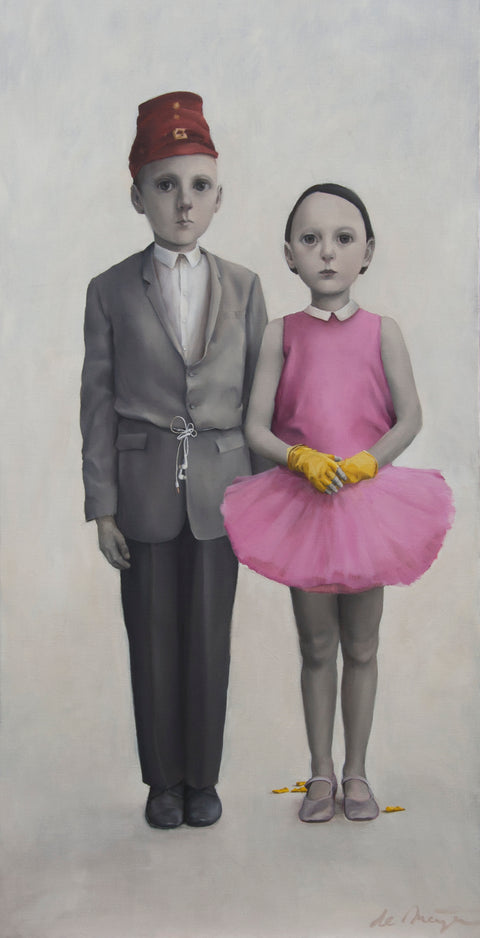
In Rebellion, a young boy and girl stand side by side, dressed in garments that evoke adulthood. Their clothing — ceremonial, aspirational — feels slightly ill-fitting, as though inherited rather than chosen. The girl’s cut gloves introduce a quiet rupture within an otherwise composed tableau.
Rather than dramatizing revolt, de Meijer presents resistance as formative and uncertain. Childhood becomes a site where expectation and agency collide. The children appear poised between imitation and divergence, embodying the tension between generational inheritance and emerging autonomy.
Rebellion reflects on how resistance is shaped within the very systems it seeks to question. The painting does not predict outcome; instead, it holds the moment of negotiation — when identity is still malleable, and the future remains contingent.
Details
- Year: 2015
- Dimensions: 78 x 48 in / 200 x 120 cm
- Medium: oil on canvas
- Availability: Placed
Description
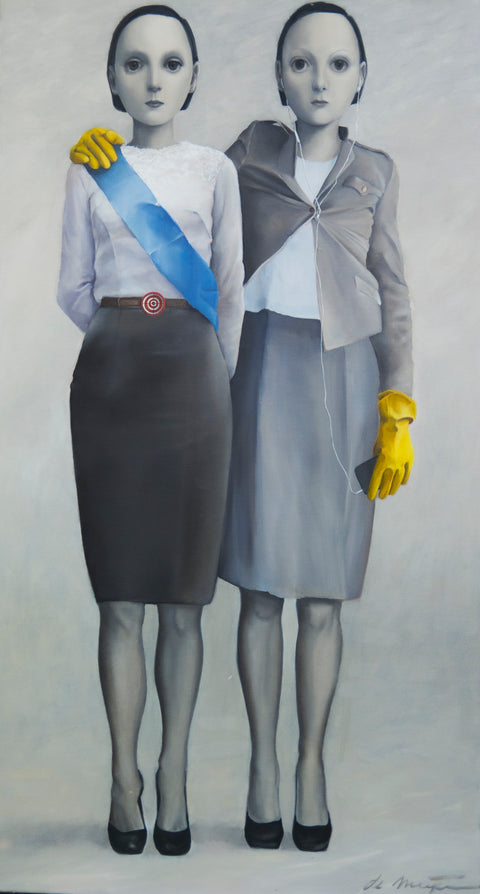
In Face Book, two women stand in close formation, their bodies nearly touching, their expressions controlled and opaque. A ceremonial sash marks one as publicly recognized, while the other — similarly dressed, similarly composed — remains adjacent rather than adorned. Their proximity suggests intimacy; their symmetry suggests rivalry.
De Meijer stages friendship as a negotiated space shaped by visibility and status. The subtle distinctions between the figures — gesture, insignia, posture — destabilize the assumption of solidarity. Admiration and ambition coexist, blurring into competition. The yellow gloves, recurring within the artist’s vocabulary, introduce a note of performance, as though both figures are aware of being seen.
Rather than condemning ambition, Face Book examines how recognition restructures social bonds. Success becomes a gravitational force, drawing others inward while simultaneously exposing the fragility of affiliation. The painting captures the moment when companionship shifts into comparison — when proximity to power becomes its own form of aspiration.
Details
- Year: 2015
- Dimensions: 78 x 40 inch / 200 x 100 cm
- Medium: oil on canvas
- Availability: Placed
Description
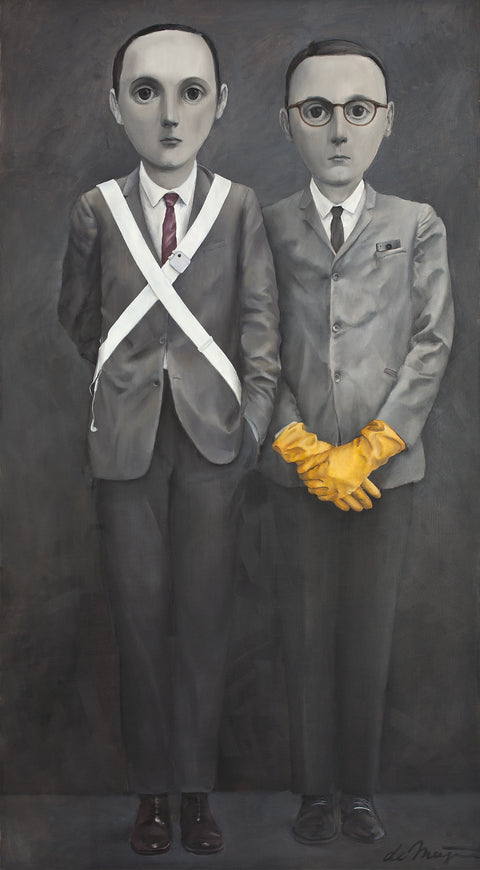
In Civil War, de Meijer recasts the financial marketplace as a theater of conflict. Two men stand in near-uniform business attire, their bodies rigid, their expressions stripped of individuality. The white cross-straps slicing across one torso evoke both ceremonial regalia and martial harness, transforming corporate dress into quiet armor.
The painting collapses the distance between battlefield and boardroom. Competition becomes ritualized combat; ambition becomes strategy. The yellow gloves — a recurring motif in the artist’s lexicon — punctuate the otherwise restrained palette, suggesting both protection and contamination. De Meijer positions status not as reward, but as a system that demands allegiance and endurance.
Rather than dramatizing aggression, Civil War isolates its psychological residue: the normalization of perpetual contest.
Details
- Year: 2015
- Dimensions: 78 x 43 inch / 200 x 110 cm
- Medium: oil on canvas
- Availability: Placed
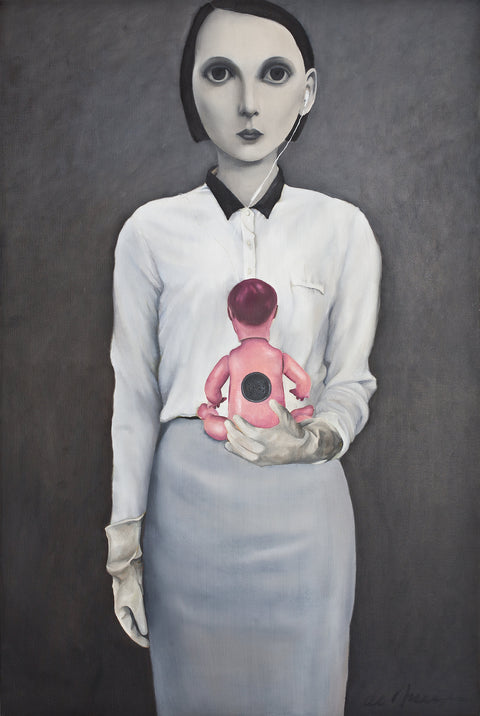
Description
In Back Up, a solitary woman stands frontal and composed, holding a pink interactive doll close to her chest. The object reads simultaneously as child, device, and surrogate — a mediated form of intimacy. Its artificiality contrasts with the subject’s still, disciplined posture.
De Meijer examines the contemporary negotiation between professional identity and biological time. The doll’s mechanical presence displaces maternal warmth, turning care into simulation. The muted tonality and controlled composition resist sentimentality, foregrounding instead a culture in which reproduction becomes strategic planning.
Back Up does not stage tragedy; it stages calculation. The painting reflects on how autonomy and expectation intersect within systems that measure success in productivity — even as they commodify intimacy.
Details
- Year: 2014
- Dimensions: 35 x 59 inch / 90 x 150 cm
- Medium: oil on canvas
- Availability: Placed
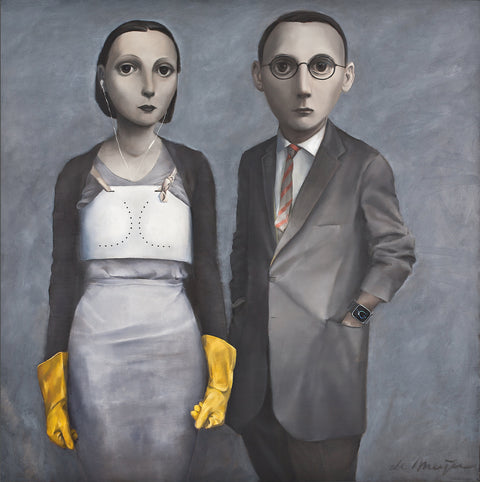
Description
In Guarded Love, de Meijer presents intimacy as a negotiated arrangement rather than an emotional bond. A sharply dressed couple stands side by side, their bodies aligned yet psychologically distant. The woman’s structured bodice resembles both garment and restraint — a subtle armor that contains rather than reveals. Her yellow gloves, luminous against the muted palette, signal protection and control.
Beside her, the man’s tailored suit and conspicuously displayed smartwatch situate him firmly within contemporary status culture. Technology becomes an extension of identity, a marker of performance and productivity. The pairing suggests a relationship calibrated by visibility and achievement rather than vulnerability.
The painting’s stillness is its indictment. De Meijer reframes partnership as transaction, asking how love mutates when measured in symbols of success. In this composition, proximity replaces closeness, and status quietly supplants sentiment
Details
- Year: 2014
- Dimensions: 63 x 63 inch / 150 x 120 cm
- Medium: oil on canvas
- Availability: Placed
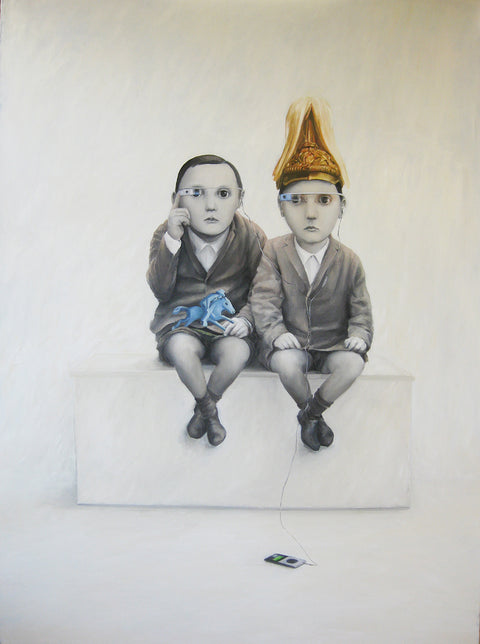
Description
In Play Mates, de Meijer situates childhood within the architecture of digital immersion. Two boys sit side by side, physically present yet psychically elsewhere. Their headgear—reminiscent of virtual-reality apparatus—suggests a generation raised within mediated environments where experience is increasingly internalized and privatized.
The composition is spare, almost clinical, amplifying the sense of detachment. A discarded device on the floor becomes a quiet relic of tactile play, displaced by simulated worlds. De Meijer does not romanticize the past; rather, she stages a tension between technological progress and sensory deprivation. The painting asks what is surrendered when imagination becomes outsourced to screens—when presence yields to projection.
Details
- Year: 2014
- Dimensions: 78 x 59 inch / 200 x 150 cm
- Medium: oil on canvas
- Availability: Placed
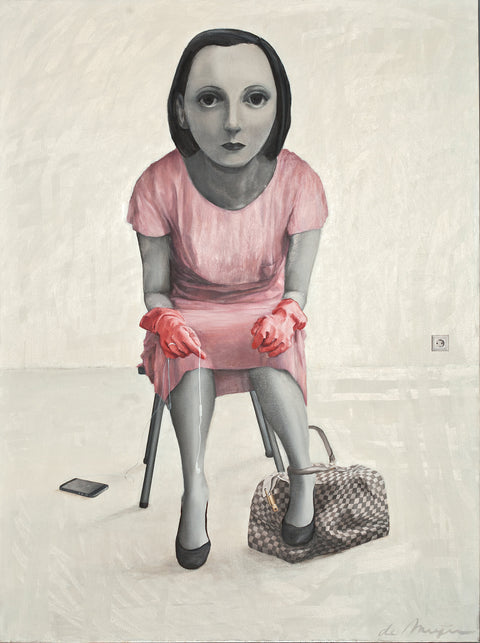
Description
In LinkedIn, de Meijer turns her gaze toward performative success culture. A woman sits in poised stillness, yet her posture betrays imbalance: one foot is entangled in the strap of an expensive handbag. The luxury object, emblem of achievement, becomes a subtle restraint.
Her blank stare resists the promise of fulfillment implied by material display. The neutral backdrop isolates the figure, transforming the scene into a study of ego and exhibition. The painting reads as a contemporary vanitas—where brand identity replaces mortality as the moral center.
Here, status is not triumphant but precarious, and aspiration edges toward self-sabotage
Details
- Year: 2014
- Dimensions: 47 x 62 inch / 120 x 160 cm
- Medium: oil on canvas
- Availability: Placed
Description
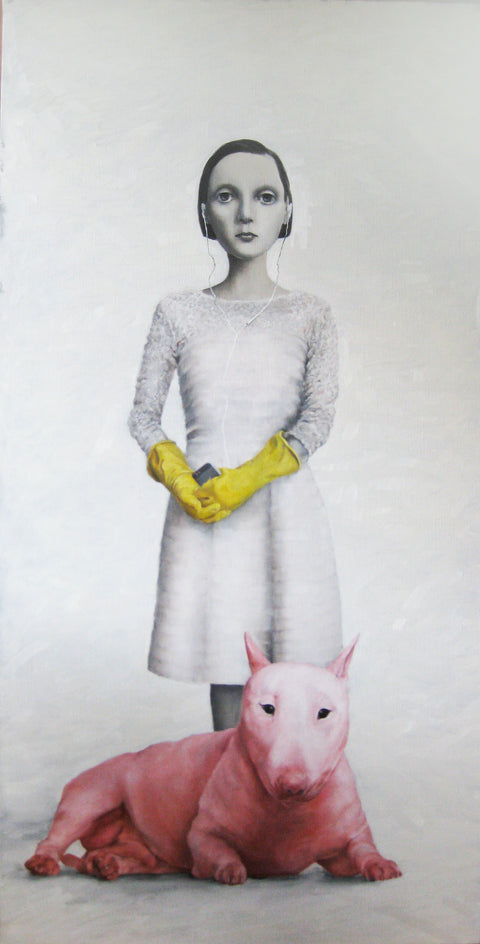
In Wall Street Bully, de Meijer constructs a portrait of ambition armored by isolation. A businesswoman stands upright, her posture controlled, almost ascetic. Bright yellow gloves—recurring emblems within the artist’s vocabulary—signal both protection and contamination: a barrier between self and environment. In her hands she discreetly holds a device, the silent conduit of market flows and perpetual vigilance.
At her feet lies a pink bull terrier, an unmistakable double of the “bull” market. The animal’s fleshy presence softens and unsettles the scene simultaneously. It operates as guardian, alter ego, and projection of aggression—domesticated power resting but never neutral. The pairing suggests that in financial culture, loyalty and combat coexist.
The composition is stripped of narrative distraction. Against a pale, undefined ground, success appears stark and solitary. De Meijer reframes the trading floor as an existential arena: competition internalized, emotion muted, companionship replaced by symbolic force. The work reads less as satire than as diagnosis—an image of triumph inseparable from vigilance, and of wealth shadowed by emotional austerity
Details
- Year: 2013
- Dimensions: 78 x 39 inch / 200 x 100 cm
- Medium: oil on canvas
- Availability: Placed
Description
In Wall Street Bully, de Meijer constructs a portrait of ambition armored by isolation. A businesswoman stands upright, her posture controlled, almost ascetic. Bright yellow gloves—recurring emblems within the artist’s vocabulary—signal both protection and contamination: a barrier between self and environment. In her hands she discreetly holds a device, the silent conduit of market flows and perpetual vigilance.
At her feet lies a pink bull terrier, an unmistakable double of the “bull” market. The animal’s fleshy presence softens and unsettles the scene simultaneously. It operates as guardian, alter ego, and projection of aggression—domesticated power resting but never neutral. The pairing suggests that in financial culture, loyalty and combat coexist.
The composition is stripped of narrative distraction. Against a pale, undefined ground, success appears stark and solitary. De Meijer reframes the trading floor as an existential arena: competition internalized, emotion muted, companionship replaced by symbolic force. The work reads less as satire than as diagnosis—an image of triumph inseparable from vigilance, and of wealth shadowed by emotional austerity
Details
- Year: 2013
- Dimensions: 59 x 47 inch / 150 x 120 cm
- Medium: oil on canvas
- Availability: Placed
Description
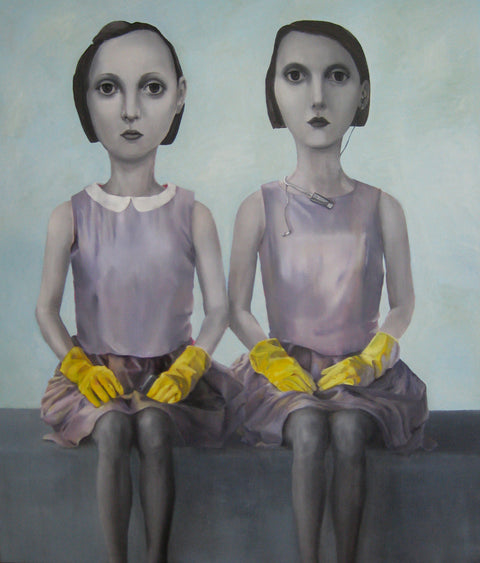
In Best Friends, de Meijer explores rivalry disguised as solidarity. Two women sit in near symmetry, their resemblance suggesting affiliation, perhaps even alliance. Yet the image vibrates with tension. Their mirroring becomes a visual strategy of competition rather than communion.
The recurring yellow gloves operate as both barrier and permission—allowing action without contact, ambition without intimacy. The gloves sanitize ambition, creating a distance between gesture and consequence. What might be read as friendship reveals itself as parallel striving: two figures locked in the same pursuit of visibility.
De Meijer’s restrained palette and frontal composition amplify the psychological charge. The painting positions image-making as a form of armor, and companionship as something negotiated within systems of status. The result is not a portrait of affection, but of adjacency—closeness shaped by comparison rather than connection.
Details
- Year: 2012
- Dimensions: 55 x 47 inch / 140 x 120 cm
- Medium: oil on canvas
- Availability: Placed
Description
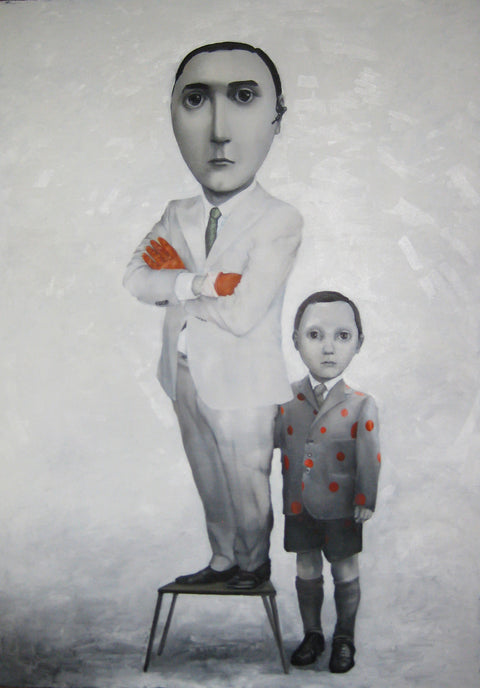
In Que Sera Sera, de Meijer distills the mechanics of inheritance into a stark, theatrical tableau. A father stands elevated on a chair, arms crossed, self-consciously asserting authority. Beside him, a young boy mirrors his posture in miniature, absorbing the performance of dominance before he fully understands it.
The raised platform becomes more than a compositional device—it is a metaphor for constructed status. Power here is not earned but staged, propped up and visibly maintained. The son’s small figure, marked with subtle red accents, suggests both innocence and inscription: the early imprinting of values, ambition, and hierarchy.
Rather than sentimentalizing generational continuity, de Meijer renders it as choreography. The painting examines how identity is modeled through proximity—how children internalize systems of authority long before they question them. The title, borrowed from a popular refrain of inevitability, adds quiet irony: what appears destined is, in fact, carefully rehearsed
Details
- Year: 2013
- Dimensions: 67 x 47 inch / 170 x 120 cm
- Medium: oil on canvas
- Availability: Placed
Description
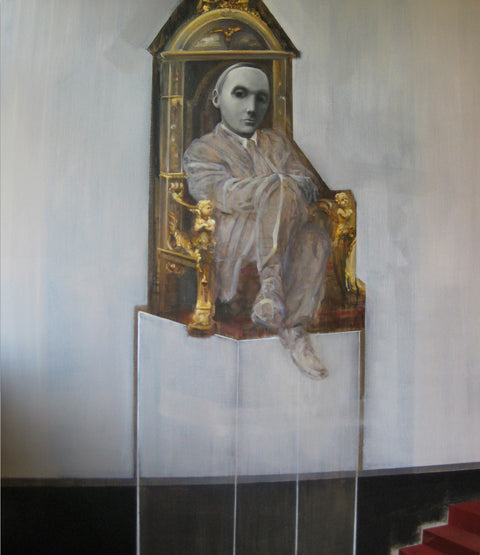
In Sacred Heights, de Meijer renders ambition as liturgy. A businessman occupies a gilded throne elevated on a stark pedestal, his ascent literalized as spiritual elevation. The gold structure evokes both altar and reliquary, conflating capital with devotion. Wealth here is not merely acquired—it is worshipped.
Notably, the figure’s body dissolves into a near-transparency, its sketch-like handling contrasting with the solidity of the throne. This attenuation suggests the erosion of self beneath the weight of status. Power remains materially present; the subject becomes spectral. De Meijer thus frames hierarchy as both aspiration and vanishing act—a state in which elevation entails a subtle loss of substance.
Details
- Year: 2011
- Dimensions: 78 x 47 inch / 200 x 120 cm
- Medium: oil on canvas
Description
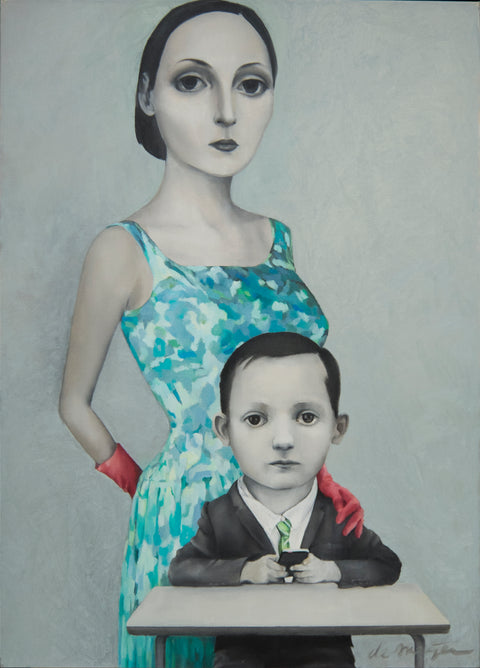
In Virtual Love, de Meijer stages generational inheritance within the domestic sphere. A mother stands behind her son, her red-gloved hands resting near him in a gesture that oscillates between protection and positioning. The child, formally dressed and composed, appears prematurely absorbed into adult codes of presentation.
The painting’s emotional temperature is restrained. Affection is present, yet mediated—filtered through expectation, technology, and performance. The boy’s poised demeanor and the mother’s composed pride suggest a continuity not only of values but of emotional economy. Childhood becomes rehearsal.
Rather than sentimentalizing maternal guidance, de Meijer interrogates it: how ambition, image-consciousness, and digital immersion are transmitted under the guise of care. The work reflects on intimacy in an era where connection is increasingly structured by devices and display, rendering closeness both visible and curiously distant
Details
- Year: 2013
- Dimensions: 55 x 39 inch / 140 x 100 cm
- Medium: oil on canvas
- Availability: Placed
Description
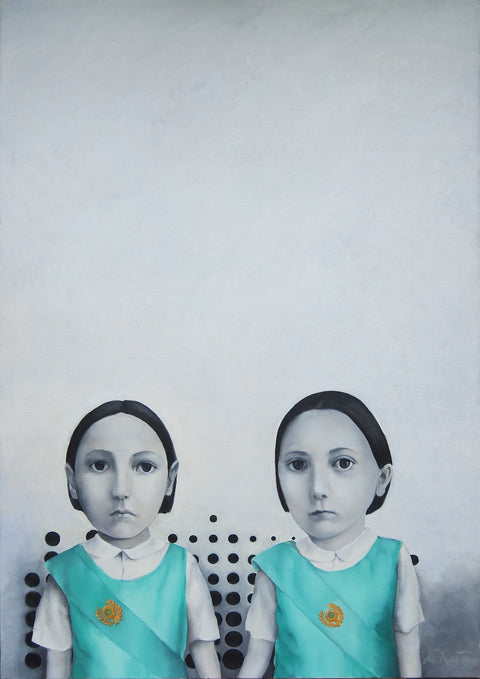
In Soul Mates, de Meijer presents two girls in matching school uniforms, standing side by side in near-symmetrical alignment. Their clasped hands suggest intimacy, yet their expressions remain restrained, composed to the point of solemnity. The uniformity of dress and posture situates them within an institutional framework where individuality yields to expectation.
The turquoise sashes and emblems introduce a subtle language of merit and evaluation, implying that achievement has already entered the sphere of childhood. The dotted field behind them evokes systems of measurement—data, grading, surveillance—quietly encroaching on play.
Rather than depicting innocence as carefree, de Meijer portrays it as structured and supervised. The girls appear bound not only to one another but to a culture of early performance. Soul Mates reflects on how ambition and conformity are instilled at formative stages, rendering companionship both refuge and shared burden within a system that leaves little room for unstructured joy.
Details
- Year: 2012
- Dimensions: 67 x 47 inch / 170 x 120 cm
- Medium: oil on canvas
- Availability: Placed
Description
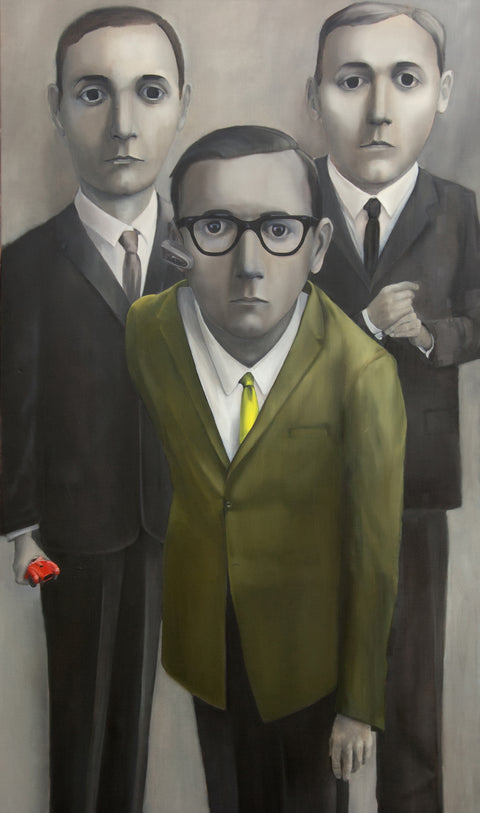
In Down the Wall, three businessmen are arranged in a compressed frontal formation, their proximity suggesting solidarity while simultaneously evoking tension. The central figure leans slightly forward, his yellow tie and green jacket marking him as leader within a rigid hierarchy. The flanking figures, nearly interchangeable, reinforce a structure of loyalty and replication.
De Meijer’s muted palette and flattened background eliminate environmental distraction, placing emphasis on psychological atmosphere. The single red accent—subtle yet disruptive—introduces a note of volatility within an otherwise controlled composition.
The work examines capitalism not as spectacle but as choreography: ambition staged as discipline, proximity mistaken for connection. Emotional warmth is absent; what binds the trio is not intimacy but shared pursuit. Down the Wall becomes a study in institutional masculinity, where value is measured in accumulation and silence
Ellen says
“It’s very cold in there.”
Details
- Year: 2011
- Dimensions: 78 x 47 inch / 200 x 120 cm
- Medium: oil on canvas
- Availability: Placed
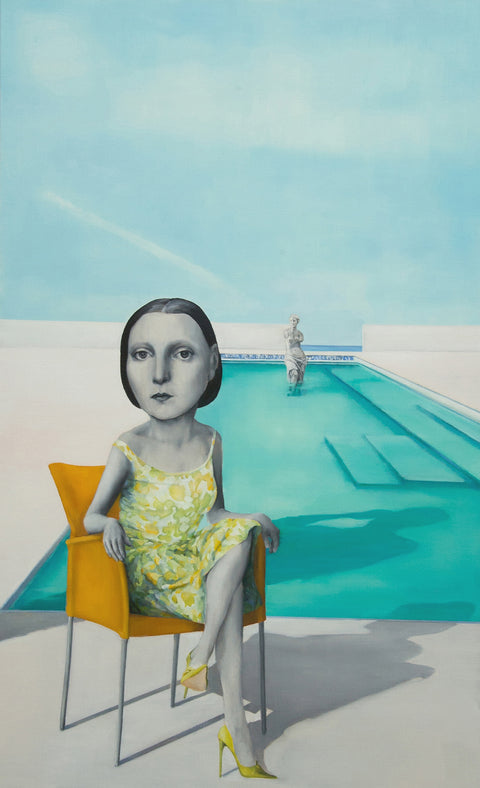
Description
In Weekend Love, a solitary woman occupies a meticulously composed poolside setting. The turquoise water and bright sky suggest leisure, yet the emotional temperature remains cool. Her posture is poised, elegant, almost statuesque—an image of cultivated affluence.
The unseen partner appears only as shadow, absorbed in a phone call. Presence is replaced by absence; intimacy by distraction. De Meijer contrasts architectural clarity with emotional vacancy, exposing the dissonance between surface prosperity and relational detachment.
The painting reflects on modern privilege as a condition of isolation. Leisure becomes performance, partnership becomes silhouette. In this staged paradise, connection recedes into reflection, and luxury reveals its quiet estrangement
Details
- Year: 2011
- Dimensions: 77 x 47 inch / 195 x 120 cm
- Medium: oil on canvas
- Availability: Placed